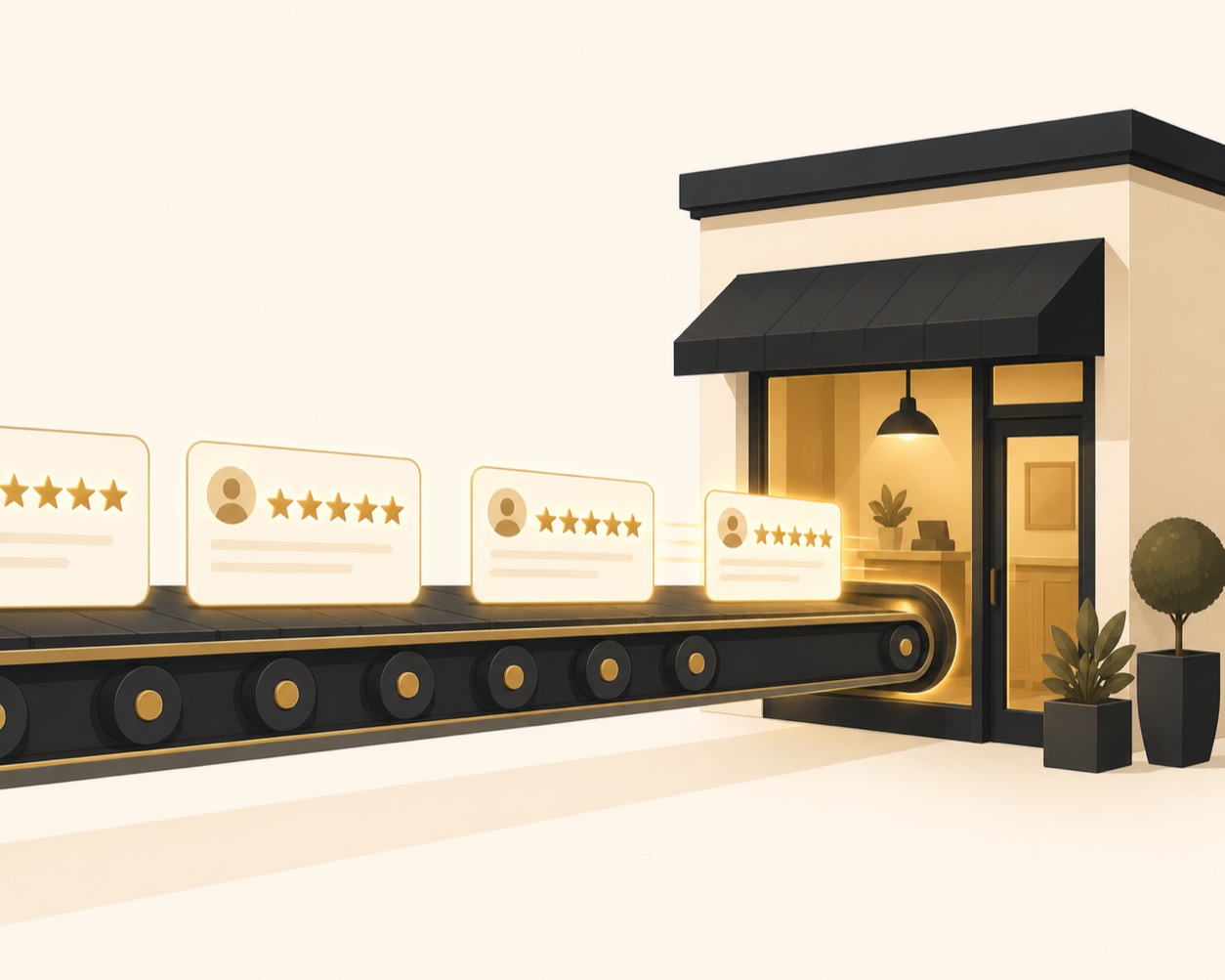
- The #1 reason businesses don't get reviews isn't bad service — it's that they never ask, or they ask badly. Nearly every happy customer will leave one if you make it a single tap at the right moment.
- Asking every customer is fully Google-compliant. Incentivizing reviews, gating out unhappy customers, or buying fake ones violates policy and risks having your reviews stripped or your profile suspended.
- Reviews carry about 16% of local ranking weight, and velocity beats volume — a steady monthly flow outranks a one-time burst, and around 150+ reviews is where AI assistants start recommending you by name.
You already know reviews matter. What most business owners don't know is that the gap between them and the competitor with 300 reviews usually isn't service quality, luck, or how long they've been in business. It's a system — a boring, repeatable habit of asking — that one of them has and the other doesn't.
This is the honest version of how to get more reviews on Google. No buying, no fake accounts, no hiding the review link from customers who might say something critical. Just the compliant, durable way to build a review engine that feeds your rankings, your conversion rate, and — increasingly — the AI assistants deciding who to recommend. From an agency that builds these for a living.
Why Google reviews matter more than ever in 2026
Reviews do three jobs at once, and each one has gotten more valuable this year.
They rank you. Review signals carry about 16% of local ranking weight in the 2026 ranking-factor studies — one of the biggest levers you have, behind only your Google Business Profile and on-page signals. And it's not just the count: velocity beats volume, so a steady flow of reviews every month outranks a one-time burst of 50 followed by silence, because Google reads the pattern, not just the total.
They win the click. When three businesses sit side by side in the map pack, the searcher's eye goes straight to the star ratings and review counts. A business with 240 reviews at 4.7 stars beats one with 19 reviews at 5.0 nearly every time — more reviews reads as more trustworthy, even at a slightly lower rating. This is the single most direct conversion signal you have, and it works before a customer has clicked anything.
They get you recommended by AI. This is the new one. ChatGPT, Gemini, and Perplexity now drive real local discovery, and they lean heavily on review data — count, rating, recency, and what the reviews actually say. Studies show AI assistants rarely name a business as a recommendation below roughly 150 reviews, and ChatGPT's picks average about 4.3 stars. The review engine you build for the map pack pays off in AI search too.
One system, three payoffs. That's why we treat reviews as core infrastructure, not a nice-to-have.
The #1 reason you don't have enough reviews
It's almost never that customers are unhappy. It's that you're not asking — or you're asking badly.
Think about the last time you left a review unprompted. For most people it's rare, and it usually happens after something went wrong. Happy customers are happy and then they move on with their day. They're not thinking about your Google profile. They will, however, leave a glowing review if you ask them at the right moment and make it take ten seconds.
The businesses with hundreds of reviews aren't serving hundreds of times more customers than you. They've just removed the two things that kill review volume: friction (the ask is hard, slow, or buried) and forgetting (nobody owns the task, so it happens sporadically or never). Fix those two and your numbers change fast — most businesses are sitting on a backlog of would-be reviewers who simply were never asked.
The compliant line: ask everyone, incentivize no one
Before the how-to, the guardrails — because this is where businesses get themselves in trouble, usually without meaning to.
Google's review policies are actually straightforward. Here's what's allowed and what isn't:
| Allowed | Against policy |
|---|---|
| Asking customers to leave a review | Offering discounts, cash, or gifts for reviews |
| Reminding them once or twice | Entering reviewers into a prize draw |
| Making it easy with a direct link or QR code | "Gating" — only asking customers you expect to be happy |
| Asking every customer, not just the happy ones | Writing reviews yourself or buying them |
| Replying to every review | Setting up a review kiosk that filters by sentiment first |
Two of these trip people up constantly, so they're worth spelling out.
Gating is not allowed — and it backfires anyway. Gating means routing customers through a survey first and only showing the Google review link to the ones who rate you highly, while steering unhappy customers to a private complaint form. It sounds clever. It violates Google's policy, review platforms actively police it, and it robs you of the single most valuable thing a negative review gives you: a public chance to respond well. The fix is to ask everyone the same way and handle criticism in the open (more on that below).
Incentivizing is not allowed — even the small stuff. A discount, a gift card, "leave a review and you're entered to win" — all of it violates Google's policy, whether the review is positive or negative. You can thank someone warmly. You cannot pay them, in any form. Genuine reviews from real customers are the only kind that count, and conveniently, they're the only kind that produce real business.
Cross that line and the downside is real: reviews get filtered or removed, your profile can get a warning label that torpedoes trust, and in serious cases Google suspends the listing entirely. Not worth it — especially when the compliant method works better.
How to actually get the reviews: timing, the ask, and one tap
Here's the engine that produces the numbers, because "just ask for reviews" isn't a system. Three things have to be right.
1. Timing — ask at peak happiness
Ask when the customer is happiest: the job's done, the problem's solved, the compliment's just been paid. Not three days later in a batch email when the glow has faded. For a home service, that's as the tech is packing up. For a restaurant or salon, it's at checkout. For a B2B service, it's right after a win or a kind word in a meeting. The closer your ask sits to the peak of the experience, the higher your completion rate — this single factor matters more than anything else in the system.
2. The ask — short, human, and specific
Give the ask a script so it doesn't depend on someone finding the right words in the moment:
"It was great working with you — if you have 60 seconds, a Google review genuinely helps a small business like ours. Here's the direct link."
That's it. It's honest, it explains why it matters (small businesses live and die on reviews, and customers genuinely want to help), and it sets the expectation that this takes under a minute. Don't over-engineer it. Don't tell them what to write. Just ask and get out of the way.
3. One tap — kill every extra step
This is where most review requests die. If your ask makes someone open Google, search for your business, scroll to find the reviews section, and tap through — you've lost most of them. Every extra step roughly halves your completion rate.
The fix is your Google review short link (find it in your Business Profile under "Ask for reviews" / "Get more reviews"). That link drops the customer straight onto the review box with the star selector open. Put it everywhere:
- In a text message sent right after the job. SMS gets read and acted on far more than email — lead with it.
- In a follow-up email as the backup, for customers who didn't tap the text.
- As a QR code on invoices, receipts, counter cards, and business cards, so an in-person ask is one camera-point away.
SMS plus email, both carrying the same one-tap link, is the combination that consistently moves the needle. The text catches most people; the email mops up the rest.
How to scale it: automation and ownership
Doing this by hand works — until you get busy, and the review asks are the first thing to fall off. That's the trap. Review volume that depends on someone remembering will always be inconsistent, and inconsistency is exactly what Google's velocity signal punishes.
Two ways to make it stick:
Give it an owner. Make sending the review request part of a specific person's actual job — the tech who closes the ticket, the front-desk person at checkout, the account manager after a win. "Ask for the review" becomes a step in the workflow, not a thing that happens when people remember. This alone transforms most businesses' numbers.
Automate the send. Better still, take the remembering out of human hands entirely. Connect your booking, invoicing, or CRM system so that finishing a job automatically triggers a review request — a text within an hour or two, then an email reminder a day later if there's no response, all carrying your one-tap link. This is how businesses generate a steady, compliant flow of reviews every single week without anyone thinking about it. It's fully within policy — you're still asking every customer, you've just made the ask reliable.
This is exactly what we built our free Get More Reviews tool to do: it fires off review requests by SMS and email automatically after each job, using your direct Google link, so the asking never slips. Set it up once and the velocity signal takes care of itself.
Don't stop at getting them — respond to every review
Collecting reviews is half the engine. Replying to them is the half most businesses skip, and it's nearly free leverage.
Reply to every single review, good and bad. Response rate is a measurable input to both your rankings and AI recommendations, and review content plus your replies gets pulled directly into AI Overviews. A thoughtful reply is free content in the highest-visibility real estate that exists.
- On positive reviews, name the service and the neighbourhood naturally — "So glad the furnace install in Kitsilano went smoothly." You're writing indexable, AI-readable text that reinforces exactly what and where you do, not just being polite.
- On negative reviews, stay calm, specific, and public. A measured reply that acknowledges the issue and offers a fix converts more readers than a wall of flawless five-stars — because it proves you're real and that you handle problems well. Resolve the details in private; never argue in the thread.
A few honest, human negative reviews handled gracefully also make your profile more credible, not less. A perfect 5.0 with zero critical reviews reads as fake to both buyers and algorithms.
What NOT to do
To be blunt about the shortcuts, because they're tempting and they all backfire:
- Don't buy reviews or post fake ones. They get filtered or removed, they can flag your profile, and they produce zero real customers. Google's detection keeps getting better; this is a dead end.
- Don't incentivize. No discounts, gift cards, or prize draws in exchange for reviews — against policy, even for honest reviews.
- Don't gate. Asking only the customers you think will be happy violates policy and costs you the chance to respond well in public.
- Don't ask in bursts. Forty reviews in launch week, then nothing for a year, reads as manipulation and wastes the velocity signal. Steady and ongoing wins.
- Don't make it hard. If your ask doesn't include a one-tap link, you're leaving most of your reviews on the table.
Every one of these is a way of trying to skip the work. The compliant system is less effort than the workarounds and produces results that actually last.
Start building your review engine
Reviews are the rare local SEO lever that pays off in three places at once — your map pack ranking, your conversion rate, and your AI visibility — and the method is genuinely simple: ask every happy customer, at the right moment, with one tap, every week. The only hard part is consistency, and that's a solved problem.
The fastest way to close your review gap is to stop relying on memory and let automation do the asking. Our free Get More Reviews tool sends compliant review requests by SMS and email automatically after each job, using your direct Google link — so the velocity signal Google rewards keeps building without you lifting a finger. It's free to start.
Want the full picture of where reviews fit alongside your profile, citations, and website? Our complete guide to local SEO in 2026 walks through the whole system in order. And if you'd like us to look at exactly where your review gap is costing you rankings, a free local SEO audit will tell you honestly — including whether reviews are the first thing you should fix.
Frequently asked questions
How do I get more Google reviews?
Ask every customer, at the moment they're happiest, with a one-tap link. That's the whole system. The businesses drowning in reviews aren't lucky — they've made asking a routine part of the job: a text with a direct Google review link goes out right after a positive experience, followed by a single email reminder. Make it someone's actual responsibility rather than a thing that happens when people remember, and the volume takes care of itself.
Is it against Google policy to ask for reviews?
No — asking customers for reviews is explicitly allowed, and Google encourages it. What's against policy is offering incentives (discounts, cash, entries into a draw) in exchange for reviews, 'gating' by only sending the review link to customers you expect to be happy, and posting fake reviews. The safe line is simple: ask everyone, incentivize no one, and let the honest reviews land where they land.
How many Google reviews do I need to compete?
There's no magic number for the map pack — consistency matters more than any single total, because a steady flow every month outranks a one-time burst followed by silence. For AI visibility the bar is higher: studies show AI assistants rarely name businesses below roughly 150 reviews. A practical goal for most local businesses is to at least match the review count of the three competitors already in your map pack, then keep the velocity going.
How do I ask a customer for a review?
Keep it short, human, and specific, and include the direct link. Something like: 'It was great working with you — if you have 60 seconds, a Google review genuinely helps a small business like ours. Here's the direct link.' Send it by text within an hour or two of finishing the job, while the experience is fresh. Texts get read and acted on far more than emails, so lead with SMS and use email as the backup.
Can you pay for Google reviews?
No — buying reviews violates Google's policies and consumer protection law in many countries, and Google's systems are increasingly good at detecting and removing them. Paid or fake reviews get filtered or wiped, can trigger a warning label on your profile, and in serious cases lead to suspension. Beyond the risk, they're pointless: fake reviews don't produce real customers, and a wall of suspiciously perfect ratings reads as fake to buyers and algorithms alike.
Should I offer a discount or reward for leaving a review?
No. Incentivizing reviews — even something small like a discount, a gift card, or entry into a prize draw — violates Google's review policies, whether the review is positive or not. You can thank customers, and you can make leaving a review effortless, but the review itself has to be freely given. The good news is you don't need incentives: timing and a one-tap link do far more for your review volume than any reward ever could.

Founder of Lead Local SEO, a Vancouver-based local SEO agency helping local businesses top Google Maps, local search and AI results.
More about Michael →We handle all of this for local businesses — every day.
Get a free audit of where you rank on Google Maps, search and AI — and a clear plan to get you to the top.
Get My Growth Plan →